- Focus
- Posts
- Beyond the Fine Print: How Competition Policy Quietly Boosts Our Economy
Beyond the Fine Print: How Competition Policy Quietly Boosts Our Economy

Sponsored by PublicSectorExperts.com
Hey there👋
For every anti-competitive merger blocked, between 4-18% of other potentially harmful mergers are abandoned before they're even proposed.
This finding from the UK Competition and Markets Authority's 2023 literature review, "Wider Benefits of Competition Policy and Enforcement," reveals just one aspect of how competition enforcement creates benefits far beyond the specific markets where authorities directly intervene.
When we hear about competition authorities blocking a merger or breaking up a cartel, it's easy to view these as isolated events affecting specific industries. But that's a bit like watching just one wave and missing the entire ocean.
I've been diving into this research on the wider benefits of competition policy, and what struck me most wasn't the direct impacts of interventions—it was the powerful ripple effects that spread throughout the entire economy.
The Deterrent Effect: The Iceberg Below the Surface

Think about speed cameras on highways. Their true value isn't just catching the speeders they photograph, but in making everyone slow down along that stretch of road.
Competition enforcement works similarly. For every cartel busted, research suggests that between 4.6 and 28 other potential cartels never form in the first place. Companies look at enforcement actions and think twice about engaging in anti-competitive behavior.
This invisible deterrent effect creates benefits many times larger than the direct interventions we see in the news.
The Productivity Puzzle
The UK, like many economies, has struggled with lagging productivity growth since 2008. It's a persistent economic challenge that affects everything from wages to living standards.
Here's where it gets interesting: effective competition policy acts as a productivity booster through two main channels:
Within companies: Competition pressure forces businesses to become more efficient
Between companies: More productive firms gain market share from less productive ones
The result? One simulation suggests competition enforcement increases real GDP by 0.6-1.1% in the medium to long term. That might sound small, but across an entire economy, that's billions in value creation!
Innovation: Not Just for Tech Companies
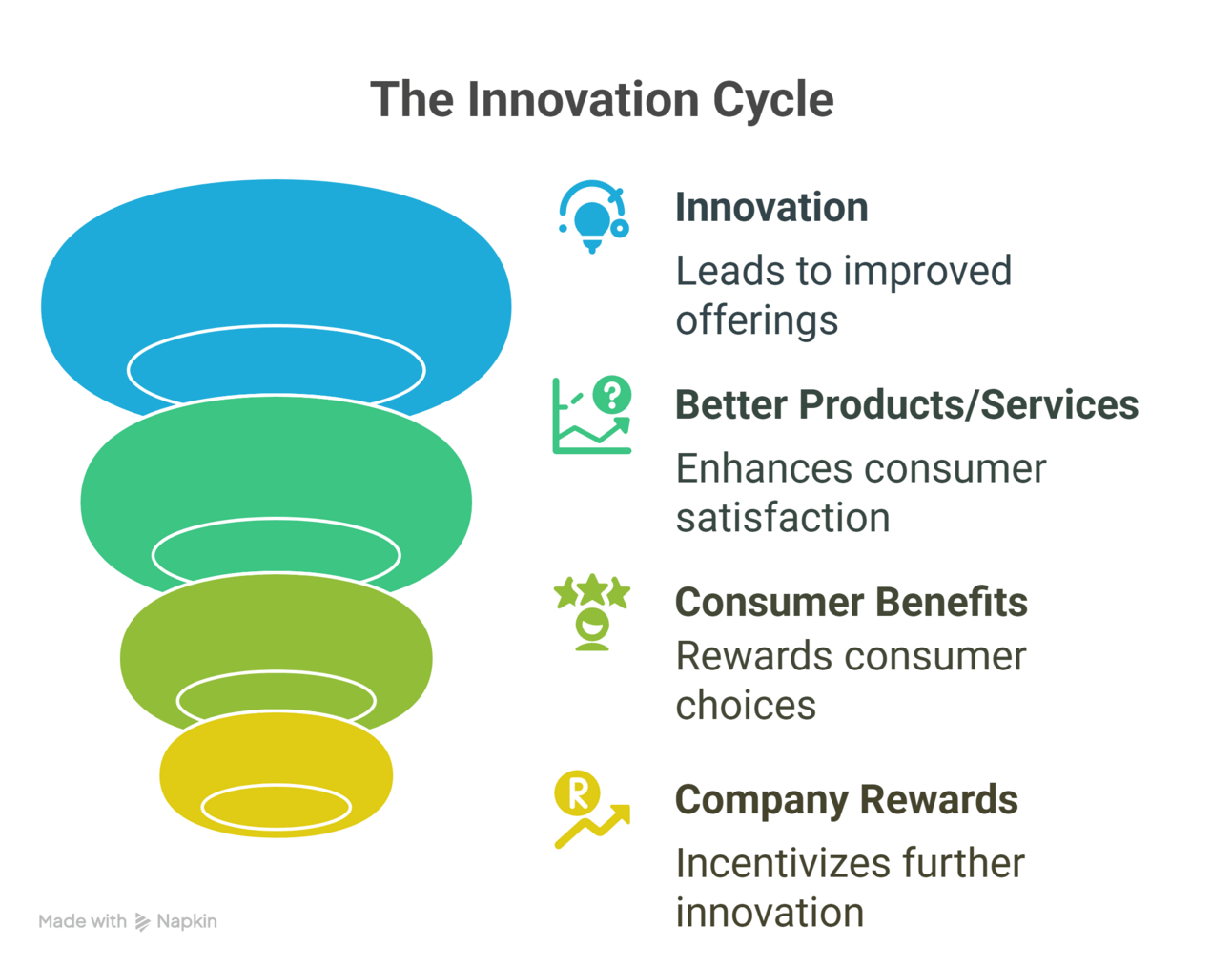
Remember the breakup of the Bell System in the US or IG Farben in Germany? These weren't just about addressing market power. They unleashed waves of innovation.
When monopolies are broken up, innovation and diversity flourish. Even when a dominant firm is highly innovative, research shows that strengthening competition in the market still results in positive innovation outcomes.
Competition doesn't just change who wins the race. It changes how fast everyone runs.
A Tale of Two Sectors
Not all parts of the economy respond equally to competition policy. The research makes a fascinating distinction:
Non-tradeable sectors (typically services that can't be imported): Competition enforcement has its strongest impact here
Tradeable sectors (goods/services facing international competition): While still beneficial, the impact is smaller
This makes perfect sense. When international competition already disciplines a market, domestic competition policy has less work to do. But what about in service markets like healthcare, professional services, or local retail? Competition authorities become critical guardians of economic efficiency.
Your Business and the Competition Ecosystem
Whether you run a small business, work in a large corporation, or simply buy products and services (which is all of us!), you're part of this competition ecosystem.
The takeaway for businesses: Competition policy isn't just something to comply with. It's an environment that rewards innovation, efficiency, and customer focus. The most successful businesses don't just avoid breaking competition rules; they thrive within competitive markets by outperforming rivals through genuine improvements rather than anti-competitive shortcuts.
The takeaway for consumers: When markets work well, you benefit not just from lower prices but from better quality, more innovation, and greater choice. Your purchasing decisions help drive this competitive process.
Where Do We Go From Here?
As we face economic challenges from inflation to productivity stagnation, effective competition policy represents one of our most powerful but underappreciated economic tools.
The next time you hear about a competition authority blocking a merger or fining a cartel, remember: you're seeing just the tip of the iceberg. Below the surface lies a much larger impact. Deterred anti-competitive behavior, improved productivity, enhanced innovation, and ultimately, a stronger economy.
What can you do? Pay attention to competition in your industry. Report anti-competitive behavior when you see it. Support policies that promote competitive markets. And perhaps most importantly, recognize that competitive markets don't just happen. They require vigilant protection.
Navigate Public Sector with Ease
Doing business with the UK public sector just got easier. PublicSectorExperts cuts through the complexity, providing the insights and guidance your business needs. From procurement strategies to policy advice, their network of professionals ensures you stay ahead. Plus, you’ll enjoy connecting with experts who make it simple and actionable for your success.

Quick Question!
Before you go, we’d love to know how today’s Focus resonated with you. Your feedback helps us improve each issue. 😊
New here? Welcome aboard! Join the Focus community to get insights straight in your inbox.
Need help standing out? Let us spotlight your business or service and partner with us.
Got a tip, question, or big win? We’re listening! Share it with us, and we’ll see it featured.
Looking for expert advice? Our team of public sector pros has your back, get in touch here.
Until next time!
Reply